• Cell Illustrator 4.0
  • Functionality
  • Key Features
  • Simulation Engines
  • Release Notes
    • Case Studies
    • Lineup
  • CI Project
  • Related Projects
  • Scientific Publications
  • System Requirements
  • Documentation/Support
  • Forum
  • Trial License - CI Pro
    • Previous Version
  • Contact


Cell Illustrator 3.0

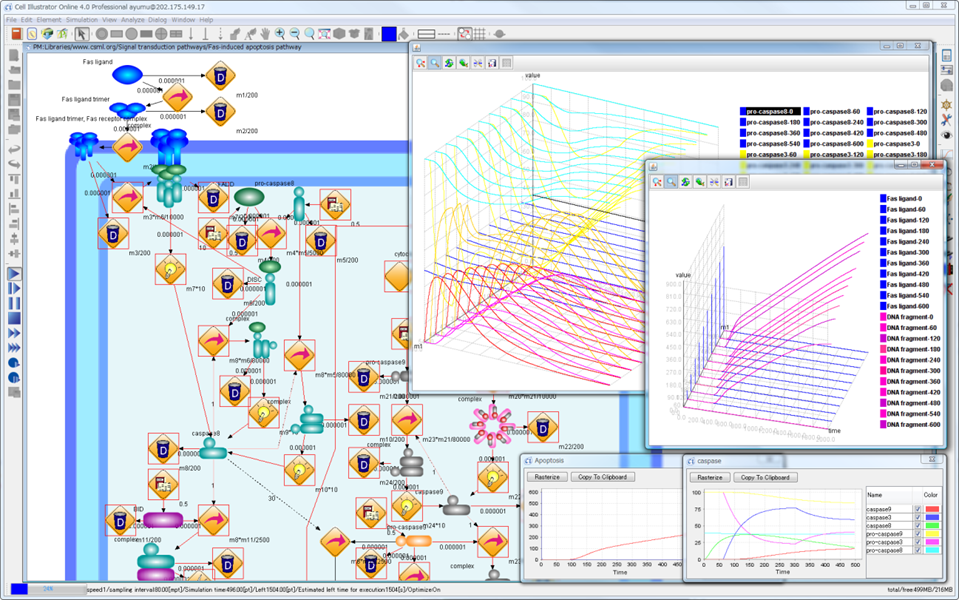
ci_logo.jpg Cell Illustrator 3.0 is a software tool that enables biologists to draw, model, elucidate and simulate complex biological processes and systems. It has outstanding drawing capabilities, moreover it allows researchers to model metabolic pathways, signal transduction cascades, gene regulatory pathways as well as dynamic interactions of various biological entities such as genomic DNA, mRNA and proteins.

Cell Illustrator 3.0 models are used to visualize biological pathways, interpret experimental data and test hypotheses. In addition, it provides researchers with model diagrams of publication quality and simulation result charts.


Downloads

  • Download Cell Illustrator 3.0 for Windows (67 MB) [ mirror ]
  • Download Cell Illustrator 3.0 for Windows with Java VM (90 MB) [ mirror ]
  • Download Cell Illustrator 3.0 for Linux (56 MB) [ mirror ]
  • Download Cell Illustrator 3.0 for Linux with Java VM (85 MB) [ mirror ]
  • Download Cell Illustrator 3.0 for Mac (65 MB) [ mirror ]
  • Download Cell Illustrator 3.0 for Unix (56 MB) [ mirror ]

The program requires a license file to be run.

  • To obtain a license for Cell Illustrator 3.0, please contact us at ccs@fqs.pl or use the contact form.
  • To evaluate the newest version of Cell Illustrator, please fill out the registration form.


Cell Illustrator 3.0 includes new features as following:

  • Import of SBML/CellML files
  • Library of SVG graphical elements
  • Enhancements in the Petri net simulation engine
  • Improved charts
  • External references
  • Gene network view
  • More than hundreds free pathway models in the CSML website that boost your modeling process.

Release Notes (html,pdf) Scientific Publications (html)

Copyright 2009 by The University of Tokyo. All rights reserved.